Canonical organism accounts for theropods, dromaeosaurs, oviraptorosaurs, and avialans.
ArchaeopteryxIchthyornisAsteriornisFrom feather to flight
Taxa Spine — Canonical Species Accounts & Preserved Anatomy
The dinosaur-to-bird transition is documented by a dense series of Jurassic and Cretaceous paravians. Below are the 10 core reference taxa defining the evolutionary spine, mapped directly to fossil Lagerstätten and assigned 5-tier evidence confidence badges.
25 canonical records.
DIRECT Archaeopteryx lithographica (von Meyer, 1861)
Clade: Avialae • Age: Late Jurassic (~150 Ma) • Locality: Solnhofen Limestone, Bavaria, Germany • Size: 0.8–1.0 kg
Preserved anatomy: Fully asymmetric flight feathers on wings and tail, paired with ancestral theropod traits including teeth set in sockets, a long bony tail (23 free caudal vertebrae), unfused ankle bones, and clawed hand digits.
Why it matters: The iconic transitional fossil linking theropod dinosaurs to modern birds. Displays fully developed asymmetric flight feathers alongside primitive reptilian skeletal features.
Literature note: Archaeopteryx is a convenient historical anchor rather than a singular 'first bird'. The 2025 Chicago specimen re-evaluation continues to refine its exact aerodynamic capabilities versus non-avian dromaeosaurids.
Primary citations: von Meyer (1861); Wellnhofer (2009); Chicago Specimen Analysis (2025).
DIRECT Deinonychus antirrhopus (Ostrom, 1969)
Clade: Dromaeosauridae • Age: Early Cretaceous (~115 Ma) • Locality: Cloverly Formation, Montana/Wyoming, USA • Size: 73 kg
Preserved anatomy: Large hyperextensible sickle claw on pedal digit II, stiffened caudal rods stabilizing the tail, and a semilunate carpal wrist bone.
Diagnostic synapomorphies: Swivel-wrist joint identical to the avian wing-folding mechanism; erect, active bipedal posture.
Why it matters: Ostrom's historic 1969 discovery that sparked the Dinosaur Renaissance, proving agile, bipedal, highly active theropods directly ancestral to birds.
Primary citations: Ostrom (1969); Gauthier (1986).
DIRECT Velociraptor mongoliensis (Osborn, 1924)
Clade: Dromaeosauridae • Age: Late Cretaceous (~75 Ma) • Locality: Djadokhta Formation, Gobi Desert, Mongolia • Size: 15 kg
Preserved anatomy: Ulnar quill knobs (papillae), long slender skull with upturned snout, sickle claw on digit II.
Diagnostic synapomorphies: Direct skeletal proof of large pennaceous wing feather attachment (remiges) on the forearm of a 2-meter dromaeosaurid.
Why it matters: Direct fossil proof of large pennaceous wing feathers on a non-avian dromaeosaurid, anchored by ulnar quill knobs.
Primary citations: Osborn (1924); Turner et al. (2007, Science).
DIRECT Sinosauropteryx prima (Ji & Ji, 1996)
Clade: Compsognathidae • Age: Early Cretaceous (124 Ma) • Locality: Yixian Formation, Liaoning, China • Size: 1.0 m length | ~0.55 kg
Preserved anatomy: Simple unbranched Stage 1 filamentous proto-feathers along spine and tail, banded tail pattern
Why it matters: Four-winged dromaeosaur demonstrating an extraordinary dual-airfoil flight experiment; melanosome CT imaging proved iridescent glossy black feathers.
Primary citations: Xu et al. (2000); Li et al. (2012, Science).
DIRECT Citipati osmolskae (Clark et al., 2001)
Clade: Oviraptorosauria • Age: Late Cretaceous (~75 Ma) • Locality: Ukhaa Tolgod, Gobi Desert, Mongolia • Size: 500 kg
Preserved anatomy: Specimen 'Big Mama' fossilized directly over a clutch of 22+ eggs in a circular nest, arms spread in open-arm wing-covering posture to protect the clutch.
Why it matters: A radically independent flight experiment utilizing a bat-like skin membrane rather than feathered wings, proving Mesozoic flight evolved multiple times.
Primary citations: Xu et al. 2015 (Nature); Dececchi et al. 2020.
DIRECT Heracles inexpectatus (Worthy et al., 2019)
Clade: Psittaciformes • Age: Early Miocene (19 Ma) • Locality: St Bathans Fauna, Otago, New Zealand • Size: 1.0 m height | ~7.0 kg
Preserved anatomy: Massive tibiotarsus and leg bones indicating giant flightless parrot
Diagnostic synapomorphies: Psittaciform cranial/pedal characters, extreme island gigantism
Why it matters: The largest parrot ever known to science—a 7 kg giant stem-parrot demonstrating Cenozoic island gigantism in New Zealand.
Primary citations: Worthy et al. 2019 (Biology Letters).
DIRECT Anchiornis huxleyi (Xu et al., 2009)
Clade: Paraves • Age: Late Jurassic (Oxfordian, ~160 Ma) • Locality: Tiaojishan Formation, Liaoning/Hebei, China • Size: Holotype ~34 cm length | ~110 g (largest specimens to ~60 cm, ~0.6-1 kg)
Preserved anatomy: Long pennaceous feathers on both the arms and the legs (four-winged paravian); melanosomes preserved densely enough across the whole body for a life-coloration reconstruction. Over 200 specimens known by 2017.
Diagnostic synapomorphies: Four-winged paravian limb plumage; first Mesozoic dinosaur with near-complete life coloration reconstructed from melanosome geometry - grey body, black-and-white banded wings, reddish-brown crest
Why it matters: The flagship taxon for fossil color, and a key four-winged transitional form. Mapping melanosomes across a whole body produced the first near-complete life coloration for a Mesozoic dinosaur: grey body, black-and-white banded wings, reddish-brown crest. Read that color as a reconstruction built by matching melanosome shape and density to living birds, not as an observed hue.
Primary citations: Hu D. et al. 2009, Nature 461:640-643, https://doi.org/10.1038/nature08322; Li Q. et al. 2010, Science 327:1369-1372, https://doi.org/10.1126/science.1186290.
DIRECT Yutyrannus huali (Xu et al., 2012)
Clade: Tyrannosauroidea • Age: Early Cretaceous (Aptian, ~125 Ma) • Locality: Yixian Formation, Liaoning, China • Size: ~9 m length | holotype ~1,414 kg (3,117 lb) (reported - verify against primary); two smaller paratypes at ~596 kg and ~493 kg
Preserved anatomy: Long filamentous feathers preserved on multiple specimens - the direct integument evidence is not confined to a single individual
Diagnostic synapomorphies: Basal tyrannosauroid skeletal characters combined with an extensive filamentous body covering; the largest dinosaur with direct feather evidence
Why it matters: The largest dinosaur for which feathers are directly preserved, and on more than one specimen. In lead author Xu Xing's framing, it dramatically increases the size range of dinosaurs with definite feather evidence. Read it next to the Tyrannosaurus rex record: a feathered basal tyrannosauroid and a scaly derived tyrannosaurid are both on the table, and the difference is the interesting part.
Primary citations: Xu X. et al. 2012, Nature 484:92-95, https://doi.org/10.1038/nature10906.
DIRECT Caudipteryx (Ji et al., 1998)
Clade: Oviraptorosauria • Age: Early Cretaceous • Locality: Yixian Formation, Liaoning, China • Size: Turkey-sized | mass not specified in the source dossier
Preserved anatomy: Symmetrical vaned feathers on the arms and tail plus a body covering of down; melanosome sampling indicates black feathers with a banded tail
Diagnostic synapomorphies: Pennaceous vaned feathers that are symmetrical, and therefore not aerodynamic - vane structure decoupled from flight function
Why it matters: The cleanest single demonstration that pennaceous feathers came before flight. The arm and tail feathers have proper vanes but are symmetrical, so they cannot have worked as airfoils - which leaves display and insulation as the functions in play. Melanosome sampling adds black plumage with a banded tail.
Primary citations: Ji Q. et al. 1998, Nature 393:753-761; Zhang F. et al. 2010, Nature 463:1075-1078.
DIRECT Ichthyornis dispar (Marsh, 1872)
Clade: Ornithurae • Age: Late Cretaceous • Locality: Niobrara Formation and others, North America • Size: Gull-sized | mass not specified in the source dossier
Preserved anatomy: CT-based cranial reconstruction showing a still-toothed jaw carrying a small kinetic beak tip, alongside a modern-grade brain
Diagnostic synapomorphies: Mosaic skull: retained marginal teeth with an incipient kinetic beak; ornithuran postcranial grade
Why it matters: The classic transitional ornithuran, bridging toothed avialans and crown birds. CT reconstruction of the skull shows a genuine mosaic - teeth still set in the jaw, a small kinetic beak at the tip, and a brain already built on the modern plan. It is the best single illustration that bird features arrived piecemeal rather than as a package.
Primary citations: Marsh 1872 (original description; predates DOI indexing); Field D.J. et al. 2018, Nature 557:96-100, https://doi.org/10.1038/s41586-018-0053-y.
DIRECT Hesperornis regalis (Marsh, 1872)
Clade: Hesperornithes • Age: Late Cretaceous • Locality: Western Interior Seaway, North America • Size: ~1.5 m length | mass not specified in the source dossier
Preserved anatomy: Large flightless skeleton built for foot-propelled diving, with teeth retained
Diagnostic synapomorphies: Hindlimb-powered diving specialisation with reduced flight apparatus, in a still-toothed ornithuran
Why it matters: A large, flightless, foot-propelled diver from the inland sea that split North America, still carrying teeth. It shows the ornithuran radiation was already pushing into demanding specialist niches before the K-Pg. Paired with Ichthyornis, it maps how wide the range of near-modern birds had become while non-avian dinosaurs were still around.
Primary citations: Marsh 1872 (original description; no DOI available in the source dossier).
DIRECT Vegavis iaai (Clarke et al., 2005)
Clade: anseriform line • Age: Late Cretaceous (Maastrichtian, ~68-66 Ma) • Locality: Vega Island, Antarctica • Size: Duck-like | mass not specified in the source dossier
Preserved anatomy: A second specimen preserves the oldest known fossil syrinx - three-dimensionally preserved and asymmetric
Why it matters: A crown-bird relative living in Antarctica alongside non-avian dinosaurs, and the only Mesozoic syrinx anyone has found. The voice box is preserved in three dimensions and is asymmetric, which points toward honking-type calls. Worth saying plainly: a syrinx is sound-producing hardware, not evidence of vocal learning - the learned-speech capacity of parrots is a separate, much later neurological development.
Primary citations: Clarke J.A. et al. 2005, Nature 433:305-308; Clarke J.A. et al. 2016, Nature 538:502-505, https://doi.org/10.1038/nature19852.
DIRECT Asteriornis maastrichtensis (Field et al., 2020)
Preserved anatomy: Nearly complete three-dimensional skull recovered by CT scanning, plus long-legged postcranial material
Diagnostic synapomorphies: Cranial mosaic combining landfowl-like and waterfowl-like features, placing it near the galloanseran root
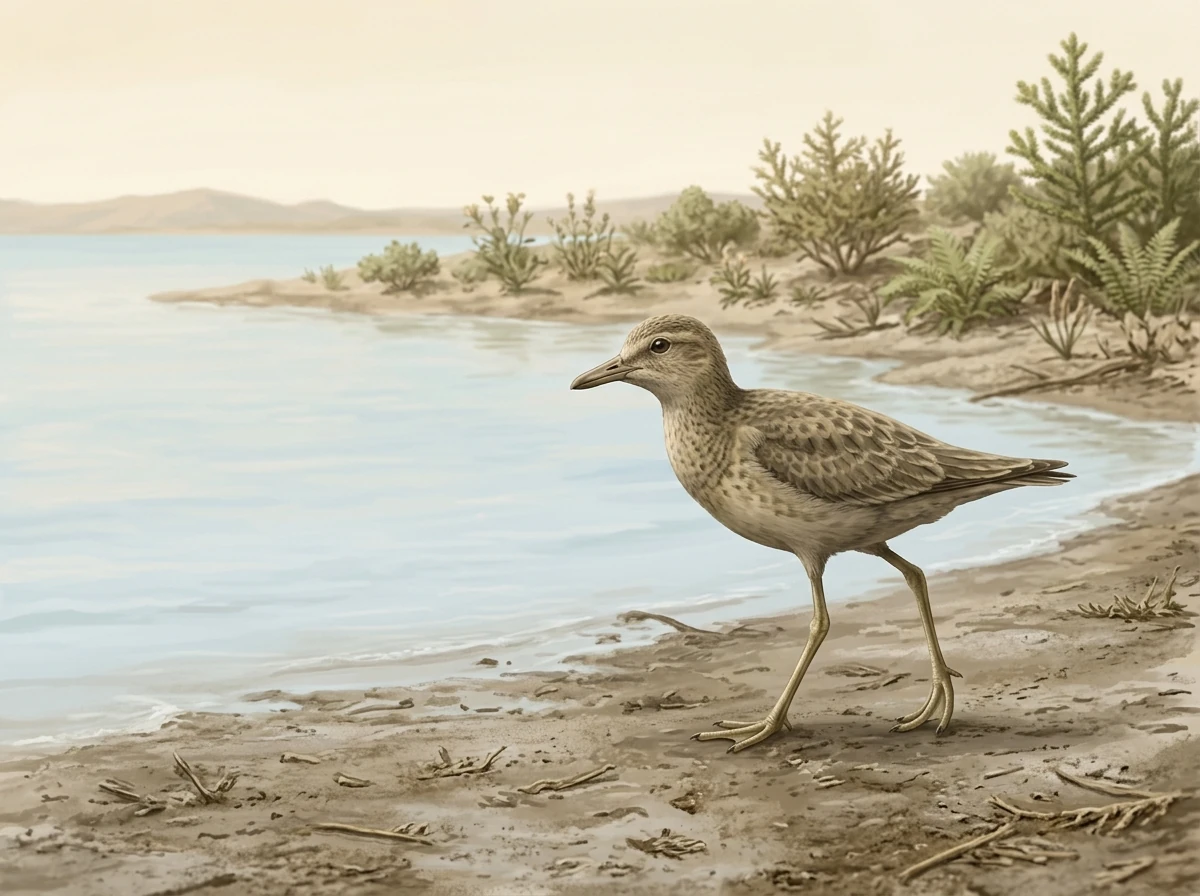
Why it matters: The 'Wonderchicken' - the oldest well-supported crown bird known from cranial remains, and a small one at roughly 395 g. It lived less than a million years before the impact, somewhere in the range of 300,000 to 800,000 years, with a skull that reads as part landfowl and part waterfowl. Being Belgian, it also complicates any strictly Gondwanan account of where crown birds started.
Primary citations: Field D.J. et al. 2020, Nature 579:397-401, https://doi.org/10.1038/s41586-020-2096-0.
DIRECT Sapeornis (Zhou & Zhang, 2002)
Clade: Pygostylia • Age: Early Cretaceous • Locality: Jehol Biota, China • Size: Long-winged basal avialan | length and mass not specified in the source dossier
Preserved anatomy: Wing feathers and reticulate foot scales preserved
Diagnostic synapomorphies: Pygostylian tail with disproportionately long wings - an early avialan flight morphology above the Archaeopteryx grade
Why it matters: A long-winged basal pygostylian from the Jehol - an early experiment in avian flight morphology beyond the Archaeopteryx grade. Feathers and reticulate foot scales are both directly preserved, so it also documents scaled feet and feathered wings coexisting on the same animal early in avialan history.
Primary citations: Zhou Z. & Zhang F. 2002 (no DOI available in the source dossier).
DIRECT Anzu wyliei (Lamanna et al., 2014)
Clade: Caenagnathidae • Age: Late Cretaceous (Maastrichtian) • Locality: Hell Creek Formation, USA • Size: ~3 m length | ~200-300 kg
Preserved anatomy: Skeletal material is DIRECT, including the toothless beak and crested skull. No integument is preserved - feathering here is BRACKETED from oviraptorosaur relatives that do preserve it.
Diagnostic synapomorphies: Caenagnathid oviraptorosaur cranial and pelvic characters at large body size; edentulous beak
Why it matters: A three-metre beaked oviraptorosaur - the 'chicken from hell' - from the last pre-impact ecosystem in North America. The skeleton is directly preserved; the feathering is not, and is inferred by bracketing against oviraptorosaur relatives whose integument survives. It is a reminder that large and strikingly bird-like were not in tension right up to the boundary.
Clade: Alvarezsauridae • Age: Late Cretaceous • Locality: Gobi Desert, Mongolia • Size: Small-bodied alvarezsaurid | length and mass not specified in the source dossier
Preserved anatomy: Skeletal material is DIRECT, including forelimbs reduced to a single stout claw. Feathers are BRACKETED, not preserved on this taxon.
Diagnostic synapomorphies: Extreme forelimb reduction to a functionally single-clawed hand, with a convergently bird-like skull and hindlimb build
Why it matters: A small alvarezsaurid whose forelimbs are reduced to one stout claw, on a body that otherwise looks strikingly bird-like without being on the line to birds. Skeletal evidence is direct; the feathers are bracketed from relatives. It is the standing example that bird-like body plans were assembled more than once inside Maniraptora.
Primary citations: Perle A. et al. 1993 (no DOI available in the source dossier).
DIRECT Ambopteryx longibrachium (Wang et al., 2019)
Clade: Scansoriopterygidae • Age: Late Jurassic (~163 Ma) • Locality: Haifanggou/Tiaojishan Formation, China • Size: Small scansoriopterygid | length and mass not specified in the source dossier
Preserved anatomy: Membranous, bat-like wing preserved along with the rod-like styliform element that supported it
Diagnostic synapomorphies: Styliform wrist element supporting a skin membrane rather than a feathered airfoil - a non-avian wing architecture
Why it matters: A second membrane-winged theropod, which is exactly why it matters - Yi qi is no longer a one-off. Both the membrane and its supporting styliform element are preserved, and aerodynamic analysis finds these animals were poor gliders and not capable of powered flight. It records a flight architecture that was genuinely tried and did not last.
Clade: Tyrannosauridae • Age: Late Cretaceous (Maastrichtian) • Locality: Hell Creek Formation, USA • Size: Mass and length not specified in the source dossier - this record is an integument case study
Preserved anatomy: Scale impressions from the abdomen, thorax, neck, pelvis and tail (reported - verify against primary), confirming scaly skin across every body region where skin is preserved. The dorsum has no skin impressions at all.
Diagnostic synapomorphies: Scaly integument over all preserved regions in a derived tyrannosaurid, contrasting with the filamentous covering of the basal tyrannosauroid Yutyrannus
Why it matters: An integument case study rather than a feather story, and the honest anchor for where feathers stop. Scales are DIRECT wherever skin is preserved - abdomen, thorax, neck, pelvis, tail - and extensive feathering is not supported by that evidence; one proposed reading is a reversion to scales in derived tyrannosaurids, possibly tied to gigantism. Because the dorsum preserves no skin impressions, sparse or patchy feathering there cannot be strictly excluded, and this remains one of the field's genuinely live arguments.
Primary citations: Bell P.R. et al. 2017, Biology Letters 13:20170092, https://doi.org/10.1098/rsbl.2017.0092.
Clade: Pan-Psittaciformes (placement unresolved - 'elusive' in recent literature) • Age: Eocene • Locality: Green River Formation/Fossil Butte Member, Wyoming, USA; London Clay, England; Messel, Germany • Size: Small arboreal birds | masses not specified in the source dossier
Preserved anatomy: Articulated Eocene skeletons across several genera - Cyrilavis, Pulchrapollia (Dyke & Cooper, 2000), Pseudasturides and Serudaptus
Diagnostic synapomorphies: Proposed stem-psittaciform cranial and pedal characters. Treat as provisional: the family's phylogenetic placement is explicitly described as elusive in recent literature, and is not settled.
Why it matters: The Eocene family that carries most of the weight in any 'early parrot' claim - and its placement is not settled, with recent literature calling it elusive. Take these as provisional stem representatives of Pan-Psittaciformes rather than settled ones. Two things belong alongside that: no crown parrot is known from the Paleogene at all, and the crown-parrot origin is calibration-dependent, spanning roughly 50-82 Ma rather than resolving to a single date.
Primary citations: Ksepka D.T., Clarke J.A. & Grande L. 2011, Journal of Paleontology 85:835-852, https://doi.org/10.1666/10-108.1; Harrison & Walker 1972; Mayr 1998 (Pseudasturidae); Dyke & Cooper 2000 (Pulchrapollia); Wright T.F. et al. 2008, Molecular Biology and Evolution 25:2141-2156, https://doi.org/10.1093/molbev/msn160; Suh A. et al. 2011, Nature Communications 2:443, https://doi.org/10.1038/ncomms1448.
Clade: Halcyornithidae (placement unresolved) • Age: Eocene • Locality: Fossil Butte Member, Green River Formation, Wyoming, USA • Size: Small halcyornithid | mass not specified in the source dossier
Preserved anatomy: Well-preserved articulated Green River skeleton - the specimen material itself is directly preserved and formally described
Diagnostic synapomorphies: Halcyornithid characters as described by Ksepka, Clarke & Grande. The stem-parrot affinity that follows from that placement is provisional, because the family's own position is unresolved.
Why it matters: The best-preserved halcyornithid, from the Green River lake beds of Wyoming. The skeleton is directly preserved and carefully described; what stays open is where the family sits, so the stem-parrot reading is provisional rather than settled. It is the closest thing Volume II has to a handoff specimen for Volume I - provided the caveat travels with it, and provided nobody calls it a parrot.
Primary citations: Ksepka D.T., Clarke J.A. & Grande L. 2011, Journal of Paleontology 85:835-852, https://doi.org/10.1666/10-108.1.
CONTESTED Psittacopes (Mayr & Daniels, 1998)
Clade: Psittacopasseres - now more often placed on the PASSERINE stem, not the parrot stem • Age: Eocene • Locality: Messel, Germany • Size: Small Messel bird | mass not specified in the source dossier
Preserved anatomy: Messel skeletal material with a short, deep, superficially parrot-like bill
Diagnostic synapomorphies: Historically read as parrot-like on bill shape. Current placement has migrated toward the passerine stem within Psittacopasseres - this record should not be presented as a stem parrot.
Why it matters: A cautionary record, kept here precisely because it is so often miscited. Long read as parrot-like on the strength of its bill, Psittacopes is now more often placed on the passerine stem rather than the parrot stem. Parrots and passerines are each other's closest living relatives within Psittacopasseres, which is exactly why bill shape alone cannot settle which side of that split an Eocene fossil belongs on.
Primary citations: Mayr & Daniels 1998 (Messel; no DOI available in the source dossier); Suh A. et al. 2011, Nature Communications 2:443, https://doi.org/10.1038/ncomms1448; Wright T.F. et al. 2008, Molecular Biology and Evolution 25:2141-2156, https://doi.org/10.1093/molbev/msn160; Jarvis E.D. et al. 2014, Science 346:1320-1331, https://doi.org/10.1126/science.1253451.