

The K-Pg Boundary
What happened 66 million years ago, and why a handful of ground-dwelling bird lineages walked out of it.

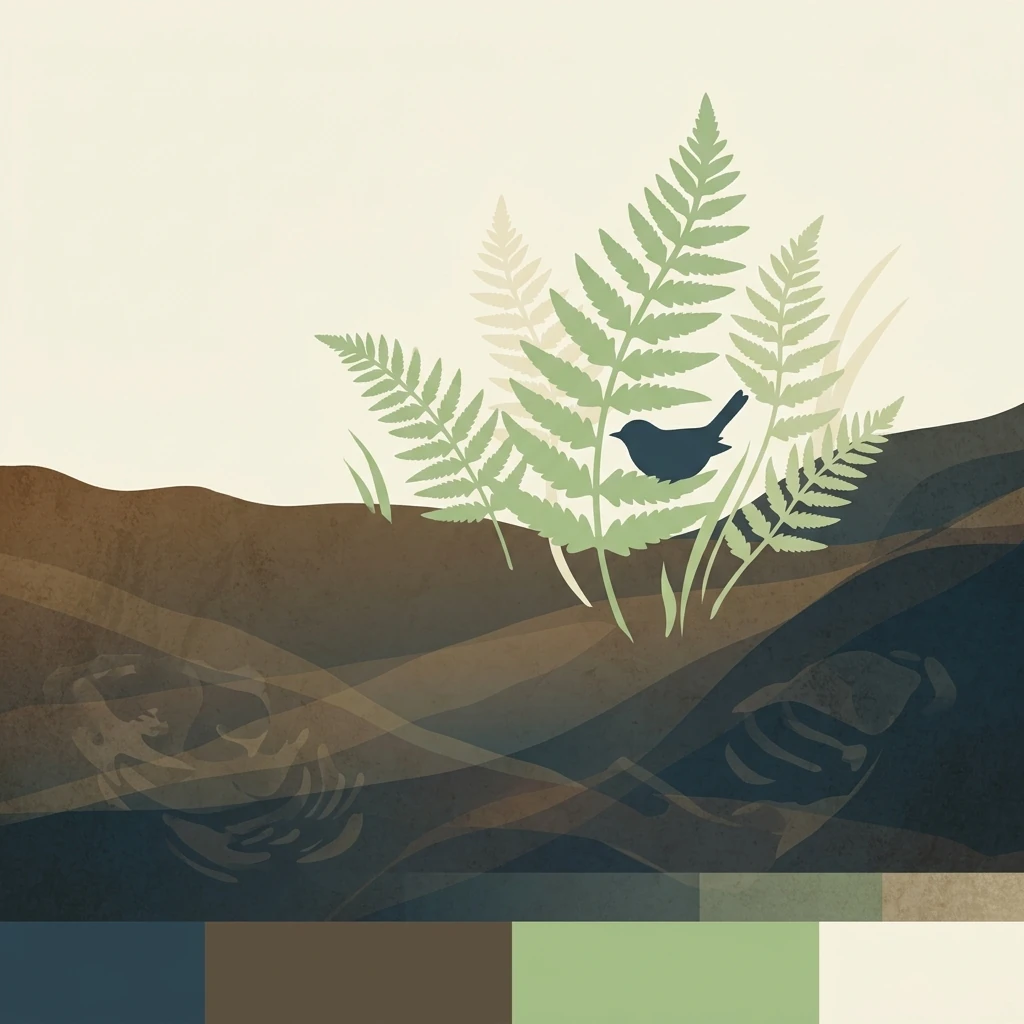
The Boundary
The end-Cretaceous extinction is one of the most precisely dated events in the whole fossil record. That precision matters here, because the question this room is really about — why birds are still with us and non-avian dinosaurs are not — only becomes answerable once you can line the impact up against the ecological record with something better than a shrug.
DIRECT Chicxulub, dated
Renne and colleagues put the impact at 66.038 ± 0.011 Ma — an uncertainty of about eleven thousand years on an event sixty-six million years old. The same work showed that the impact and the mass extinction were, in Paul Renne's phrase, “synchronous to within a gnat's eyebrow.”
One housekeeping note that keeps readers from double-counting the evidence: the figure of ~66.043 ± 0.043 Ma that circulates in chronostratigraphic charts and crater literature traces back to this same study. It is the same measurement carried through a different pipeline, not an independent confirmation of it.
DIRECT The fern spike
Three independent lines of physical evidence sit under everything else on this page, and all three are read straight off the rock rather than inferred: impact ejecta and the iridium anomaly marking the boundary layer, ⁴⁰Ar/³⁹Ar geochronology supplying the date, and palynology — fossil pollen and spores — recording a “fern spike” across the boundary, the signature of global forest collapse.
That last one is the hinge. The forests really did come apart, and we know it from plants, not from birds. Everything that follows about avian survival is an attempt to explain a bird pattern using a plant fact.
Why Birds Survived
“Birds survived the asteroid” is true in the same loose way that “mammals survived” is true — which is to say it hides the interesting part. The extinction was highly selective within birds. Whole lineages of Cretaceous birds went out with the non-avian dinosaurs. The useful question is not whether birds made it, but which ones, and what sorted them.
DIRECT The forests went first
The paleobotanical record shows global forest collapse at the boundary. The enantiornithines — the arboreal stem birds of the Cretaceous — disappear with them. This half of the argument rests on fossils of plants and fossils of birds, both observed.
BRACKETED The ancestors were on the ground
The other half is a reconstruction, not an observation. Field and colleagues used ancestral-state reconstruction — inferring the habits of ancestors from the distribution of habits among their descendants and relatives — to conclude that ancestral crown birds were predominantly non-arboreal across the K-Pg. No fossil says this directly. It is a statistical inference over a tree, and it is only as good as the tree and the coding of living habits underneath it.
The filter, stated plainly. Birds did not survive because they were birds. Ground-dwelling lineages survived a world with no canopy; tree-dependent lineages did not. The arboreal habit that we now think of as quintessentially avian was re-acquired afterward, when the forests came back — modern birds went back up into the trees, they did not stay there. Keep the two halves of this claim separate when you repeat it: the forest collapse and the enantiornithine extinction are directly evidenced; the non-arboreal ancestral condition is reconstructed.
The Contributing Factors, Honestly Weighted
Two other explanations get attached to the survival story regularly. Both are reasonable. Neither carries the weight the forest-collapse filter does, and it's worth being clear about why.
INFERRED Seed-eating and the toothless bill
Larson and colleagues proposed that granivory — feeding on durable, dormant seeds through a stretch when photosynthesis was suppressed — helped toothless, beaked birds through the crisis. It is a plausible contributor.
But Field and colleagues make a pointed objection: teeth don't preclude granivory. Toothed birds could eat seeds too, so a toothless bill cannot by itself explain who lived and who died. Treat seed-eating as contributory, not decisive — a factor that may have helped survivors persist, not the filter that selected them.
INFERRED Small body size — the Lilliput effect
Across the boundary there is a transient selection for reduced body size, the pattern paleontologists call the Lilliput effect. Small-bodied lineages fare better through the interval, and body sizes trend down before recovering.
The word doing the work is transient. This is a boundary-crossing signal, not a permanent reorganization of who is allowed to be large — and like the seed argument, it describes a bias in the odds rather than a hard gate.
Who actually made it through
Three lineages carry the crown-bird signal across the boundary:
- total-clade Palaeognathae
- Galloanserae
- terrestrial total-clade Neoaves
DIRECT The best fossil anchor near the boundary is Asteriornis maastrichtensis — the “Wonderchicken” — from the Maastricht Formation of Belgium at roughly 66.7 Ma. It is small, about 395 g, long-legged and near-shore, and a nearly complete three-dimensional skull was recovered by CT. It lived less than a million years before the impact, somewhere on the order of 300,000–800,000 years. A stem-galloanseran combining landfowl- and waterfowl-like features, it is the oldest well-supported crown bird known from cranial remains, and its Northern-Hemisphere occurrence challenges a strictly Gondwanan origin for crown birds.
A correction to our own earlier page: a previous version of this room counted four surviving neornithine lineages. The tally above — three total-clades — is the one we now stand behind.
What this room does and does not show. Demonstrated: the impact's date to within about eleven thousand years, its synchrony with the extinction, the global forest collapse, the loss of the arboreal enantiornithines, and a crown bird alive within a million years of the boundary. Reconstructed: that the ancestors of surviving birds were mostly ground-dwellers. Contributory but unresolved in weight: seed-eating and small body size. Anyone telling you exactly why your parrot's ancestors specifically got through is telling you more than the evidence does.