

Feather Evolution Lab
Developmental 5-stage model, thermoregulation, display, and melanosome color science.
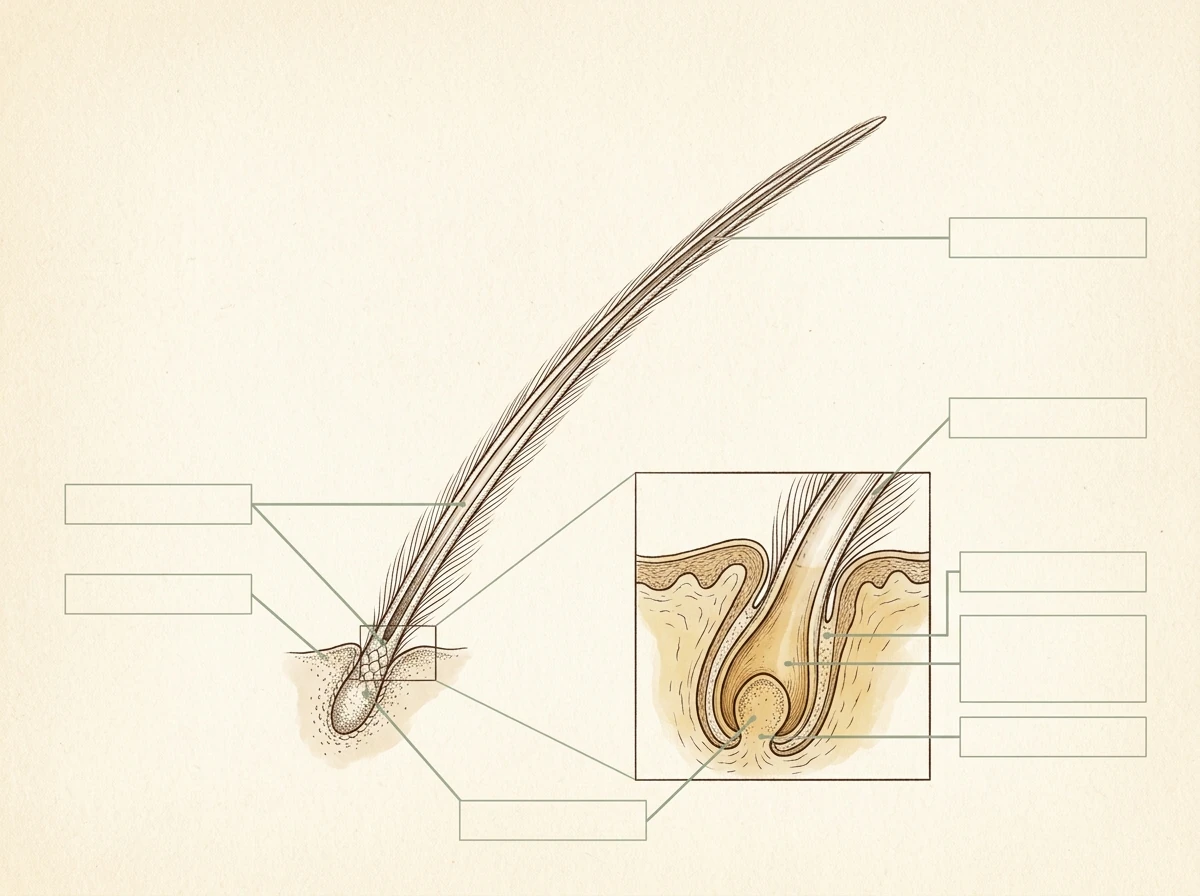

How a feather gets built
BRACKETED The Prum & Brush five-stage model
The five-stage model is not a line-up of fossils. It's a sequence of developmental innovations in the feather follicle — each stage a new thing the follicle can do, and each later stage only possible once the earlier one exists. It was built from how feathers grow in living birds, which is why it carries a bracketed tag rather than a direct one. Fossils spanning the stages then corroborate it directly.
- Stage I — a single undifferentiated tubular filament.
- Stage II — unbranched barbs growing from a follicle collar: a tuft of barbs.
- Stage IIIa — a rachis with barbs, but no barbules.
- Stage IIIb — barbs with barbules, but no rachis.
- Stage IIIa+b — the two branches converge: rachis, barbs and barbules together.
- Stage IV — a closed pennaceous vane, with differentiated barbules and hooklets holding the vane shut.
- Stage V — further diversification, including vane asymmetry.
Stage III is where short summaries go wrong. It's routinely written as one rung on a ladder — "barbs on a central rachis" — but in the model as published it bifurcates. Stage IIIa is the rachis innovation: barbs fused to a central shaft, with no barbules. Stage IIIb is the barbule innovation: branched barbs carrying barbules, with no rachis at all. They are two separate things a follicle can invent, in either order, and the lineage that has both arrives at Stage IIIa+b. Only after that does the closed vane of Stage IV become reachable. A model that branches is a different claim than a model that climbs, and the branch is the part worth keeping.
CONTESTED The Burmese-amber Stage IIIb feather — reported, and not clean to publish
A three-dimensional down feather matching Stage IIIb has been reported from Burmese amber (Roy and colleagues, 2020). Two separate cautions attach to it, and neither has been resolved.
The first is evidentiary: the report circulated as a preprint, so it has not carried a completed peer review behind it. Treat the specimen as a claim, not a fixed point in the model.
The second is ethical, and it's the heavier one. Amber from Kachin State in Myanmar is linked to armed conflict and human-rights abuses, and the country's export law is a grey zone between gemstone and fossil. On 21 April 2020 the Society of Vertebrate Paleontology wrote to more than 300 journals requesting a moratorium on fossil specimens in amber from Myanmar acquired after June 2017, when the Tatmadaw began its offensive to seize the mines; a second letter after the February 2021 coup states that "a continued moratorium is still warranted on the publication of fossil specimens in amber obtained from sources in Myanmar after January 2021," and names the military conglomerates Myanmar Economic Corporation and Myanmar Economic Holdings Ltd. Some journals changed policy, others dissented, and uptake stayed low: of 222 amber papers published between June 2020 and June 2022, 9 — four percent — addressed the ethical issues at all.
This site's policy follows from that. We show amber material only where pre-June-2017 provenance is documented, and we say so on the record rather than in a footnote.
The model's real claim is modest and strong at once: feathers were assembled by a follicle acquiring one new trick at a time, in a branching order, and the early stages arrived long before anything about them could have been aerodynamic.
Reading colour out of the rock
DIRECT Anchiornis huxleyi
The first Mesozoic dinosaur to have a near-complete life colouration reconstructed from its melanosomes: a grey body, black-and-white banded wings, and a reddish-brown crest. Dense sampling across the body is what made a whole-animal reconstruction possible rather than a patch. More than 200 specimens were known by 2017.
DIRECT Sinosauropteryx — countershading
Melanosome mapping recovered a banded tail and a countershaded body — darker above, lighter below. Countershading is a pattern with an ecological reading attached to it, which is why this animal keeps turning up in discussions of habitat and predation as well as colour.
INFERRED Microraptor — iridescence
Melanosome geometry and packing support a glossy black, iridescent plumage. Note the tier: the melanosomes themselves are preserved and directly observed, but iridescence is a structural effect, and reading it out of fossil melanosome arrangement is an inference rather than a measurement of the colour itself. See the limits below.
CONTESTED What melanosomes cannot tell you
The method works like this: fossil melanosomes are measured for shape and density, then compared against a training set of melanosomes from living birds whose colours are known, using quadratic discriminant analysis. Geometry in, predicted hue out. It's a real method with real results — and it has hard edges that any honest colour reconstruction has to state.
- Structural colour isn't preserved. Iridescent and structural colours depend on the spacing of nanostructures, and that spacing does not survive fossilisation. Reconstructions of gloss and iridescence are inferences from melanosome arrangement, not readings of the optical structure that produced the colour.
- Whole pigment classes are invisible. Carotenoid- and psittacofulvin-based colours leave no melanosome signal at all. Reds and yellows produced that way simply do not appear in the data — which matters directly for Volume I, because parrot reds and yellows come from psittacofulvins. A fossil animal reconstructed as grey could have carried colours this method cannot see.
- The rigour is disputed. Some critics question whether melanosome geometry alone reliably predicts hue, and whether the analyses have been applied with enough control. That argument is live.
The right way to hold these reconstructions is as hypotheses with confidence bands: strong for the presence and distribution of melanin, weaker for exact hue, weakest where structural colour or non-melanin pigment could have been involved.
Fossil colour science tells you where the melanin was, with real confidence. It does not tell you what the animal looked like — those are different statements, and the gap between them is where every reconstruction lives.
What were feathers for?
CONTESTED Insulation, display, water repellency — an open question, and not an exclusive one
One thing here is settled: Prum and Brush point out that Stage I and Stage II feathers could not have been aerodynamic. A single filament, or a tuft of unbranched barbs, has no vane and no surface to work against the air. Whatever the first feathers were doing, they were not flying.
What they were doing is the open part. Insulation, communication and display, and water repellency have all been proposed as the first function, along with brooding. The debate is usually staged as a contest, but the functions are not mutually exclusive — a filamentous body covering can trap air, shed water, and carry a signal at the same time, and a structure that starts useful for one reason tends to get recruited for others. We present this as unresolved because it is, and because "which came first" may be the wrong shape of question for a structure that could do several things from the start.
DIRECT Caudipteryx — the vane arrives before the flight
A turkey-sized oviraptorosaur with vaned feathers on its arms and tail and a covering of down over the body. The vaned feathers are symmetrical, which is to say non-aerodynamic — in the vocabulary of the five-stage model, a closed vane without the asymmetry of Stage V. Melanosome sampling gives black feathers with a banded tail.
Why it matters: this animal has pennaceous feathers and cannot use them to fly. Whatever those feathers were for here — display, insulation, or both — the structure clearly evolved before the function that later made it famous.
DIRECT Yutyrannus huali — feathers at nine metres
Long filamentous feathers preserved on multiple specimens of a basal tyrannosauroid. As lead author Xu Xing put it, Yutyrannus "dramatically increases the size range of dinosaurs for which we have definite evidence of feathers." The ~1,414 kg figure traces to reporting rather than a verbatim primary-text table — treat the number as reported and verify against the paper before quoting it as hard.
DIRECT Tyrannosaurus rex — where the feathers stop
Skin impressions from the abdomen, thorax, neck, pelvis and tail preserve scales. Extensive feathering is not supported by that evidence. The honest version has one more clause: the dorsum has no skin impressions, so sparse or patchy feathering along the back cannot be strictly excluded — what the fossils contradict is extensive feathering, not every feather.
Set beside Yutyrannus, this is a reversal within one lineage: feathered basal tyrannosauroids, scaly derived tyrannosaurids, possibly tied to gigantism. Feathers are not a one-way ratchet.
Feathers appear on animals that cannot fly, at sizes that cannot fly, and then disappear again in at least one lineage. Function has to be argued case by case — the structure itself doesn't come with a purpose attached.
Older than the dinosaurs?
BRACKETED Filaments outside the theropod line
Simple filamentous integument is not confined to theropods. Kulindadromeus zabaikalicus preserves filaments on an ornithischian — the other great branch of Dinosauria — and comparable structures are reported in Tianyulong and Psittacosaurus. If those structures are the same thing as theropod protofeathers, then simple feathers sit at or near the base of Dinosauria itself, far below birds.
That inference is bracketed, and it's genuinely contested. The alternative is convergence: filamentous body coverings evolving more than once, in lineages that had reason to want them, without a single shared origin. The fossils are direct; the single-deep-origin reading of them is not settled, and this page does not settle it.
CONTESTED Pterosaur pycnofibers
Anurognathid pterosaurs preserve pycnofibers with feather-like branching, and with melanosomes inside them. The structures are directly preserved — that part is not in dispute.
What the structures mean is. The reading that pycnofibers are homologous with feathers would push feather origins outside Dinosauria entirely, deep into the archosaur line. Other workers argue pycnofibers are not homologous to feathers at all, and that branching integument can be arrived at independently. Both readings are in the literature, the argument is active, and it is not this site's job to pick a winner.
The safe summary: filaments turn up on both branches of Dinosauria and on pterosaurs. Whether that's one deep origin or several independent ones is the live question — and either answer moves feathers well outside the story of birds.