
Strigopoidea
New Zealand parrots, including kākāpō, kea, and kākā lineages, branch deeply from other living parrots. Their history is central to conservation because several surviving species face severe introduced-predator and habitat pressures.
Fossils provide scattered anatomical snapshots; DNA compares living and recently extinct lineages. Together they reveal strong major branches while leaving some dates and finer relationships open to revision.
Classification changes at family, subfamily, and genus levels, but this three-part framework remains a useful orientation.
New Zealand parrots, including kākāpō, kea, and kākā lineages, branch deeply from other living parrots. Their history is central to conservation because several surviving species face severe introduced-predator and habitat pressures.
Cockatoos form a distinct radiation characterized in part by an erectile crest and differences in plumage structure and pigment. They are not simply large “true parrots,” even though both groups share broader psittaciform traits.
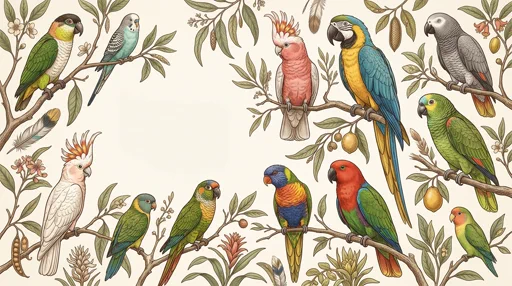
The broad true-parrot radiation includes African parrots, New World parrots, lorikeets, budgerigars, lovebirds, and many Australasian and Asian groups. Genomic work continues to refine relationships within this diversity.
The oldest confidently placed fossils set a minimum age for a lineage. Molecular clocks estimate earlier splits by combining genetic differences with calibration points, but results depend on models and fossil assignments. That is why a single “55-million-year parrot origin” headline is too tidy: Eocene fossils illuminate early parrot-like birds, while molecular analyses can infer deeper Cretaceous or Paleogene divergences.
Classification reference: a peer-reviewed nomenclature review supports the three-superfamily framework while explicitly tying ranks to the state of phylogenetic understanding. Read the Psittaciformes classification paper. A newer species-rich genomic dataset is archived at Dryad.