Birds are living dinosaurs—and the transition was branching, not linear.
Fossils show many combinations of feathers, wings, tails, teeth, wrists, air-filled bones, and locomotion. The evidence is strongest when we compare whole patterns across many species rather than searching for one missing link.
Evidence pattern
Why birds sit inside Theropoda
Shared derived features, fossil sequences, and modern anatomy converge on the same relationship.
Feathers and wings
Feathered non-avian dinosaurs demonstrate that feathers preceded modern birds. Early coverings likely aided insulation or display; later aerodynamic feathers and wing arrangements supported maneuvering, gliding, and powered flight in different lineages.
Skeleton and posture
The furcula, three-fingered hands, specialized wrists, hollow or air-filled bones, S-shaped neck, and hind-limb similarities connect birds with maniraptoran theropods. No one trait carries the argument alone.
Breathing and growth
Bird lungs use a rigid gas-exchange structure ventilated by air sacs. Fossil evidence for air-sac invasion of bones in dinosaurs helps trace parts of this system, while eggs, brooding positions, and growth tissues add behavioral and developmental evidence.
Fossil spotlight
Archaeopteryx is a mosaic, not a ladder rung
Archaeopteryx, from Late Jurassic limestone in what is now Germany, combines asymmetrical flight feathers and wings with teeth, a long bony tail, and clawed fingers. It remains important because that mixture records a real evolutionary neighborhood. Calling it “the first bird” can mislead: the boundary between bird and close bird-like dinosaur depends on definitions, and new fossils continually refine the branching tree.
Flight itself also need not have appeared in one jump. Feathers, shoulder motion, wrist folding, balance, jumping, incline running, gliding, and powered flapping can each be studied as components that changed in different sequences.
Modern meaning
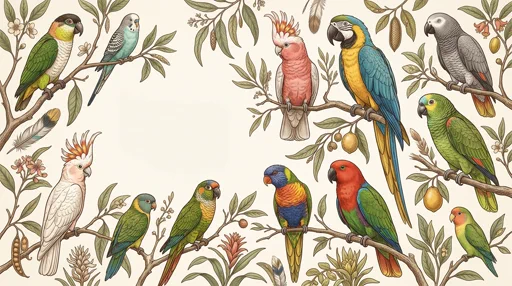
A parrot is not a primitive leftover
Modern parrots are highly specialized crown birds. Their climbing feet, curved mobile upper beak, vocal learning, play, and social cognition evolved long after early avian forms. “Living dinosaur” describes ancestry; it does not mean a companion parrot should be treated as a miniature movie monster or as behaviorally unchanged for millions of years.
Evidence guide: the Smithsonian's fossil activity compares flight-related features across non-avian dinosaurs and birds and emphasizes exaptation rather than a single sudden origin. Smithsonian: Dinosaurs Take Flight.